| |||||
 |
 |
 |
 |
 |
 |
 | |||||
A Global Warming Primer Note: All figures below are from my textbooks and based on published scientific data. Most misconceptions about global warning surround confusion over what is "certain" and "uncertain" in the science behind it. Some parts of the science are indeed uncertain, but others are not. To clarify which is which, here are four questions that everyone should ask (and be able to answer) about global warming: Question 1: The basic claim of global warming is that a higher atmospheric concentration of carbon dioxide will make Earth warmer. Is there any doubt that, all other things being equal, higher carbon dioxide concentrations do indeed make planets warmer?
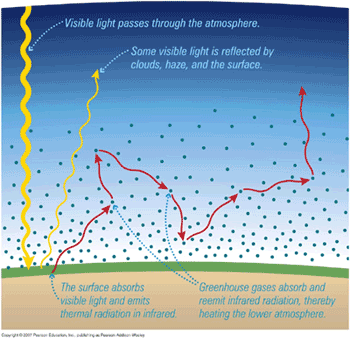
Answer: No. Carbon dioxide and other "greenhouse gases" (including water vapor and methane) are molecules that absorb infrared light and thereby cause what is known as the greenhouse effect; for those who are interested, the figure below shows the basic mechanism. The greenhouse effect is so well understood that you will not find any scientists who dispute it. Indeed, the greenhouse effect occurs naturally on Earth, and that turns out to be a very good thing: Without it, Earth would be far too cold for liquid water or life. Studies of other planets show that the greenhouse effect can be even more important in determining a planet's surface temperature than the planet's distance from the Sun. Venus provides the most extreme example: Although Venus is closer to the Sun than Earth, its clouds are so reflective that less sunlight reaches Venus's surface than Earth's surface. As a result, without the greenhouse effect, Venus would be colder than Earth. But because Venus has a thick atmosphere containing far more carbon dioxide than Earth's atmosphere (by a factor of about 170,000), Venus's actual surface temperature is a searing 870°F. Given that the naturally occurring greenhouse effect is a good thing for life on Earth, Venus offers proof that it's possible to have too much of a good thing.
Answer: Not any more. For awhile, there were questions concerning whether temperature data were being analyzed correctly, but those doubts have been almost entirely dispelled (see the second and third items in the "postscript" section below). Since the dawn of the space age, we've had satellite data from which to make measurements of Earth's global average temperature. Data from earlier times were local rather than global, which means there are greater uncertainties in converting them to a global average. However, by studying a great variety of data sources (ranging from newspaper temperature reports to natural records like those in tree rings), the uncertainties have been reduced enough to make the trend quite clear. The graph below shows the results: The global average temperature has increased about 0.8°C (1.4°F) in the past century, and the warming appears to be accelerating during recent decades.

Question 4: OK, so there's no doubt that carbon dioxide raises a planet's temperature, that we're increasing Earth's carbon dioxide concentration, and that Earth is already showing signs of warming. Then what is uncertain about the science of global warming?
Answer: The uncertainty concerns the timing and the precise nature of the consequences of global warming. Earth's climate has numerous complexities and feedbacks that could alleviate, moderate, or exacerbate the consequences of global warming over the next few decades to centuries. It is this uncertainty that has provided room for a small number of scientists (and a larger number of non-scientists) to question the general consensus that we should be taking immediate steps to reduce global warming. Remember, however, that even among the very few scientists who count themselves as "global warming skeptics," there is no dispute that significant warming would eventually occur. It's just that they think we can safely wait for new technologies rather than taking expensive action now. From my perspective, this is rather like having a doctor tell you not to worry about quitting smoking, since we may find a cure for lung cancer before you die from it. With that, you can now understand the nature of the IPCC report. It is not a report about whether the basic science of global warming is real - there's no doubt about that. Rather, it is a report about attempts to predict the short-term (decades to centuries) consequences of global warming. In essence, hundreds of the world's leading climate scientists got together to sift through research conducted by thousands of their colleagues, in an attempt to consolidate all this research into one "best estimate" of the problem we face. This best estimate could certainly be overstating the short-term problem (as the "global warming skeptics" argue), but it could also be understating it. Personally, I suspect that it is understating the consequences in at least one critical area: sea level rise. The report predicts only a modest rise in sea level (though still bad news for the vast numbers of people living in low-lying coastal areas), but in making this prediction the IPCC scientists decided not to take into account recent data showing an unexpectedly rapid melting of polar glaciers (especially in Greenland; see figure below). If these new data hold up to further scrutiny (and I think they will), the expected sea level rise will be much more significant. And while even at this accelerated rate it would probably take many centuries to melt all polar ice, remember this fact: Melting of the Greenland ice sheet would raise sea level about 20 feet, and melting of the Antarctic ice sheet would raise sea level more than 200 feet. Are you willing to risk setting our planet on a course where future generations will need deep-sea diving gear to visit places like New York City and San Diego?

So there you have it. There's really very little uncertainty surrounding the entire global warming issue, and what little there is concerns only whether we need to worry immediately or if we can afford to wait a few decades. My opinion is that we cannot afford to wait, because the risks are simply too great. To help you make up your own mind, I suggest that you take the "letter to your grandchildren test": Imagine writing (or actually write one!) a letter that will be placed in a time capsule for your children or grandchildren to read in 50 years, telling them what you did to help alleviate global warming, or why you decided that no action was required. Then ask yourself: How will they feel about the decisions you made? Postscript Since you will surely encounter them on the news, I suppose I should also address the small but vocal group of people who go around claiming that global warming is some kind of hoax. Like those who claim NASA never landed on the Moon or that the Grand Canyon proves Earth is only 6,000 years old, the best way to combat these folks is to understand the flaws in their claims. I can't go into all of the arguments here, but to start with you should realize that most of their "facts" are at best distortions and at worst outright lies. Here's a few examples:
Just for fun, here is what planetary scientist (and co-author of my astronomy texts) Nick Schneider calls "the four levels of denial" for global warming: Level 1: "The Earth is not warming up." (denying the data) Don't you think it's time to get out of denial? ---Jeffrey Bennett |
|||||
   | |||||
 Primer